Keyword Map
One row per page: the primary keyword, supporting terms, the intent, the current position from Search Console and the action: keep, rewrite, merge or create.
I’m Ujjwal Rupakheti, an SEO specialist and full-stack developer in Itahari, Nepal. My keyword research gives you a keyword map: every page on your site matched to one main search, the intent behind it and the questions it must answer, in English, Romanised Nepali and Devanagari. It’s part of monthly SEO from NPR 30,000.
website banauneRomanised
website design NepalEnglish
वेबसाइट बनाउनेDevanagari
01What you get
Keyword research services find the searches your customers already type, sort them by intent and assign each one to a single page. With me you get six things, delivered in a shared sheet you can follow while it’s being built.
One row per page: the primary keyword, supporting terms, the intent, the current position from Search Console and the action: keep, rewrite, merge or create.
Each keyword marked informational, commercial, transactional or local, so a buying search lands on a service page and a question lands on a guide.
The pages your search competitors rank with that you don’t have yet, and the weak spots in the pages they rank with now.
Questions from People Also Ask, autocomplete and forums, grouped by page. They become FAQ sections and short answers AI assistants can quote.
For each new or rewritten page: title, H1, headings, questions to answer, internal links and the proof to include, so a writer can start straight away.
Pages competing for the same search, with a plan to merge, redirect or re-target them, so Google isn’t left choosing between two weak pages.
02Example
A keyword map is a table with one row per page. Each row names the page’s main search, its intent and the reason it deserves its own page. This is how the local pages of the Hotel Aarohi website line up with searches. I designed, built and optimised that site for local search in Chandrapur.
| Page | Main search | Intent | Why it gets its own page |
|---|---|---|---|
| Best hotel page | best hotel in Chandrapur | Local, commercial | Guests compare places to stay in the town |
| Restaurant page | Thakali food in Chandrapur | Local | Diners search for food, not for a hotel |
| Things to do | things to do in Chandrapur | Informational | Visitors plan a trip before they book |
| Rooms | hotel rooms in Chandrapur | Transactional | The booking enquiry happens here |
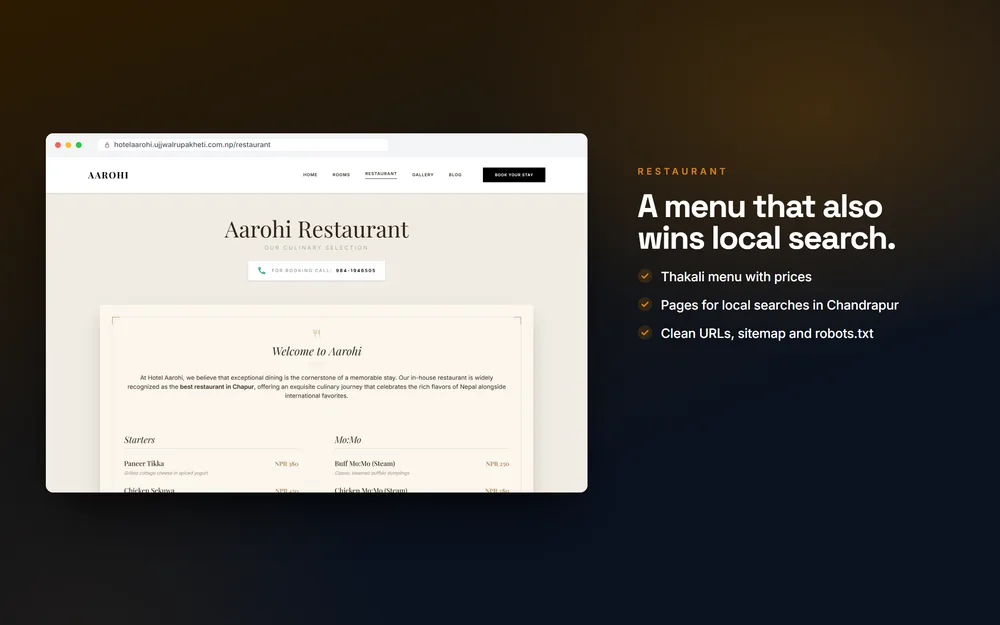
Case study: Hotel AarohiGuests looking for a room in Chandrapur search for the town, not the hotel’s name, so each of these pages has its own title, description and Hotel structured data.
03Search intent
Search intent is the job a person wants done when they type a query. I check it by reading the current Google results for each keyword. If the top results are guides, the keyword needs a guide; if they’re service pages or map results, it needs a service page or a strong local SEO presence.
| Intent | Example search | The page that fits |
|---|---|---|
| Informational | how to register a company in Nepal | A guide or blog post that answers the question first |
| Commercial | best laptop under 1 lakh in Nepal | A comparison or review with prices in rupees |
| Transactional | buy wedding card online Nepal | A product, pricing or service page with a clear way to order |
| Local | hotel in Chandrapur | A local landing page plus a Google Business Profile |
| Navigational | eSewa login | Only worth targeting for your own brand |
Getting intent wrong is a common reason a good page doesn’t rank. A service page built for the search “SEO cost in Nepal” struggles, because Google shows price guides for that query. That’s why my own pricing detail sits in a guide, SEO cost in Nepal, as well as on the services page.
04Nepal
Keyword research in Nepal has three quirks. Many searches are too small for tools to measure. People mix English, Romanised Nepali and Devanagari. And most searches happen on phones, often with a town name such as Itahari, Dharan or Butwal added.
I treat tool volumes as a rough guide and confirm demand with your Search Console data, autocomplete, People Also Ask and the questions customers send on WhatsApp or Facebook. Thirty visits a month from people ready to buy can beat thousands of casual ones.
A customer may type website banaune, website design Nepal or वेबसाइट बनाउने. I list each version, check whether Google treats them as the same search, and decide whether they belong on one page or on separate Nepali and English pages.
Nepali searches often carry a city name, “price in Nepal”, “near me” or a payment method such as eSewa or Khalti. These words signal buying intent, so they belong on service, product and local pages.
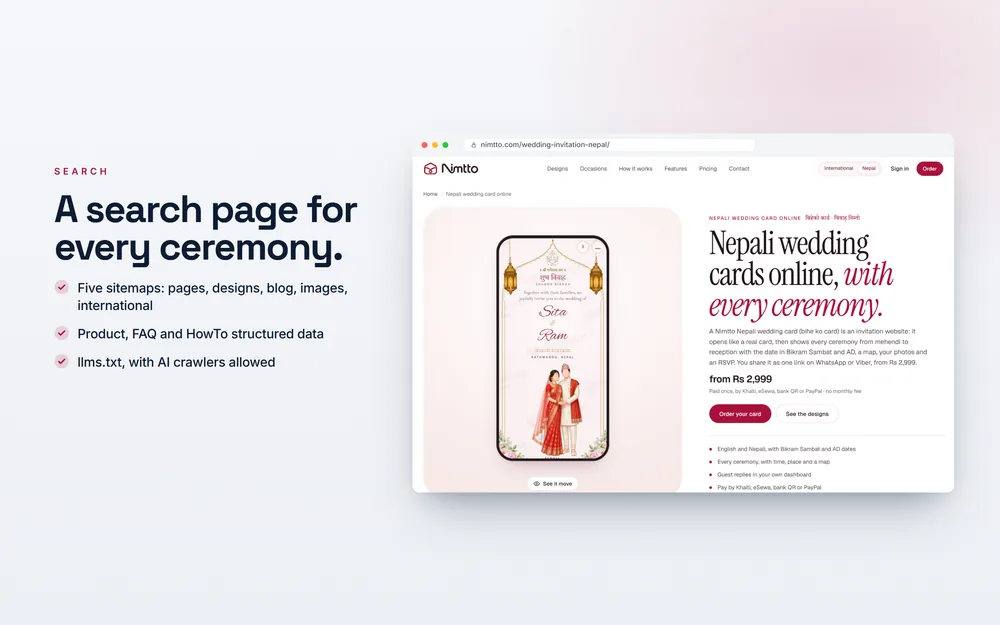
If you sell to the diaspora or to clients overseas, I research those markets separately. Nimtto (nimtto.com), for example, runs a separate international site priced in USD, with hreflang keeping the Nepal and international pages apart.
05Why it matters
Keyword research decides which pages your website needs and what each one is called. Done first, it shapes the menu, the URLs and the copy, so every page has a clear search to win. Done after launch, it usually means renaming pages, rewriting copy and setting up redirects that a little planning would have avoided.
On Nimtto, every invitation design and ceremony has its own indexable page, and long-form pages such as “Nepali wedding card online” answer the broad search. Planning a new site? Decide the pages with your web developer in Nepal before the design starts.
Process
Five steps, from a call about your business to a walkthrough where we agree what to write or fix first.
Your customers, services, locations and the enquiries that actually pay.
A crawl of your site and Search Console, to see which searches already bring impressions.
For each candidate keyword I read the live results and note intent, page types and competitors.
Every keyword assigned to one page, with intent, priority and the action to take.
A call to agree priorities, then briefs for the first pages to write or fix.
I start with free data: Search Console, Keyword Planner and the live results. I add a paid tool such as Ahrefs or Semrush when the market is competitive enough to need one. My guide to the best SEO tools for Nepal compares them.
06Who it’s for
Keyword research pays off most before a new website, a redesign or a content plan, and when a site gets traffic but few enquiries. If you already have a recent map, you probably need content or a technical audit instead.
Pricing
Keyword research is included in my monthly SEO plans, which start from NPR 30,000 a month. As a stand-alone project, it gets a fixed quote after a short call, based on the number of pages and markets.
| Service | Starting price | Typical timeline |
|---|---|---|
| Monthly SEO with keyword researchThe map, briefs, content, fixes and a monthly report | NPR30,000 / month | Map in the first month |
| Stand-alone keyword mapPriced by pages, services and markets | Fixed quote | Date agreed in the quote |
| Technical SEO auditA good partner if the site also has crawl or speed problems | NPR15,000 | 1 week |
Paid tool subscriptions are not included. International clients are quoted in USD and can pay by bank transfer, Wise or PayPal. See the full table on my services page, or read about the technical SEO audit.
Tools, Nepali searches, cost and what a keyword map can and can’t do.
Ask me on WhatsAppKeyword research is finding the words and questions people type into Google, judging how much each one matters to your business, and deciding which page should answer it. The result is a keyword map that guides your site structure, your content and your internal links, so every page has one clear search to win.
Most tools estimate search volume from limited data, and many Nepali searches are too small for them to measure. A tool showing zero doesn’t mean nobody searches. I confirm demand with Search Console, autocomplete and People Also Ask, and by asking which words your customers use when they call or message you.
Yes. I research English, Romanised Nepali and Devanagari versions of each search and check whether Google treats them as one search or several. Where they differ, I recommend separate Nepali and English pages linked with hreflang, as on Eknas, which has a full Nepali version.
It depends on the size of the site and the number of markets. A business site with a handful of services needs far less time than an online store with hundreds of products. On a monthly plan the first map is ready in the first month, and for a stand-alone project you get a delivery date in the written quote.
Keyword research is part of my monthly SEO plans, which start from NPR 30,000 a month. A stand-alone keyword research project gets a fixed quote after a short call, based on the number of pages, services and markets. The full price table is on my services page.
I start with free sources: Google Search Console, Keyword Planner, autocomplete, People Also Ask and the live results themselves. For competitive markets I add Ahrefs or Semrush for competitor gaps. Tools suggest; the live results decide, because they show what Google already rewards. My SEO tools guide lists the options.
No. Keywords that share an intent belong on one page, even if they’re worded differently, because Google shows the same results for them. A separate page only makes sense when the results are different, for example a guide for a question and a service page for a buying search. Splitting one intent across pages usually weakens both.
First I find the pages competing for the same search in Search Console. Then I choose the stronger page, merge the useful parts of the weaker one into it and set a 301 redirect, or re-target the weaker page at a different search. Internal links are updated to point at the page that should win.
No. Keyword research tells you which searches are worth winning and which page should win each one. Rankings then depend on the quality of those pages, the technical health of the site and the links it earns. Anyone who guarantees a position is guessing.
Send your website and the services you sell. I reply within one working day with questions or a first estimate. Want the bigger picture first? Read my guide on how to do SEO in 2026.
Ujjwal RupakhetiReplies within one working day
What are you planning?
Opens WhatsApp with your message started.