
Inventory Software
Stock per branch and warehouse, purchases and sales with 13% VAT bills, transfers between branches, low-stock alerts and barcode or QR scanning on a phone.
I’m Ujjwal Rupakheti, a software developer in Itahari who builds management system software in Nepal: HR and payroll, inventory, CRM, bookings and ERP-style systems that put several departments in one place, with VAT, SSF, TDS and Bikram Sambat dates built in. Eutaa, my company system, is used every day at Ektukra.
Payroll, Kartik 2083Sample company · 24 staff
Needs approvalPayslipsApprove run
Attendance this week
SunMonTueWedThuFri
22 of 24 in today · 2 on leave
01The basics
Management system software keeps one part of a business in order, such as people, stock, customers or money, in one shared place instead of spreadsheets and chat groups. An ERP joins several of those parts, so a sale, a payment and a stock change are each recorded once and every report agrees.
02HR & payroll
Payroll in Nepal has to handle Social Security Fund contributions, 11% from the employee and 20% from the employer, TDS on salary by slab, and a fiscal year that starts in Shrawan. Most foreign HR tools handle none of them.
I build HR and payroll software with those rules inside the product, the way I did in Eutaa. It runs inside a company’s private workspace, so its screens aren’t public, but a separate demo is available for walkthroughs.
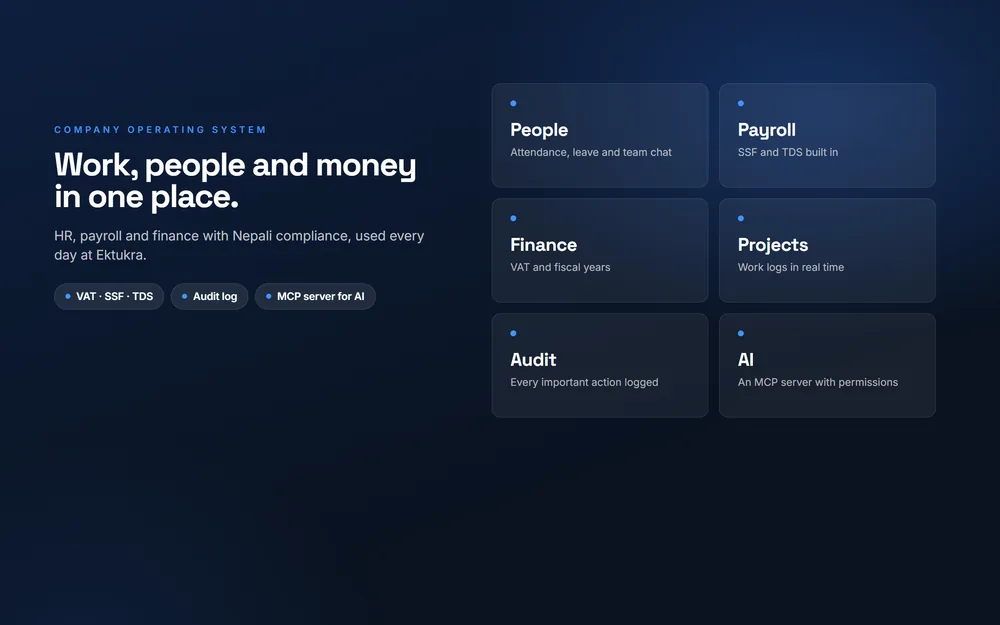
03Inventory, CRM & ERP
They differ in scope but rest on the same foundations: clear roles, a full history of every change, reports people trust and data you can export. I start with the module that hurts most and connect the others later, so nobody is retrained on everything at once.
Stock per branch and warehouse, purchases and sales with 13% VAT bills, transfers between branches, low-stock alerts and barcode or QR scanning on a phone.
Leads from your website and WhatsApp in one list, follow-up reminders, full customer history and reports by branch and staff member, like the analytics in Eknas.
Requests, quotes, dispatch, refunds and settlements as proper screens, as in the HeliGo Nepal admin console, with every amount kept in paisa.
HR, payroll, finance and projects on one database with one login, so reports agree across departments. Eutaa is built this way.
Tracking IDs, assignment to crews, escalation after 48 hours, a ward heatmap and PDF reports, as in the CivicSathy project.
CAS ratings, marks, attendance and report cards in Nepali and English for grades 1 to 10, with office review before results go out, as in Prishta.
04Custom or ready-made
Choose ready-made software when it already fits your process and Nepali rules at a fair price. Choose a custom system when your process is your advantage, when you pay monthly per user for a tool that half fits, or when no product handles VAT, SSF and TDS the way your accountant needs.
| Custom system | Ready-made software | |
|---|---|---|
| Getting started | A first module in weeks | Days |
| Cost | A one-time build per module, plus hosting | Monthly, often per user |
| Fits your process | Built around it | You adapt to it |
| Nepali rules | VAT, SSF and TDS in the data model | Depends on the vendor |
| Your data | In your database, exportable | In the vendor’s system |
Still unsure? A free consultation call is the right size for this decision, and I’ll tell you if a ready-made tool is the better buy.
05From Excel
Most systems I build replace spreadsheets someone has kept for years. The switch is where projects usually go wrong, so I treat it as part of the build, not an afterthought.
Attendance files, payroll workbooks, stock counts and the notebook at the counter. Knowing who edits what shows where the real rules live.
The same employee, product or customer often appears under three spellings. We agree one record for each before anything is imported.
Sheets in Nepal often mix Bikram Sambat and AD dates. Each date is converted once, checked, and stored so both calendars can show it.
The import is a script, not copy and paste, so it can be corrected and run again until every number is right.
Headcount, leave balances, stock on hand and unpaid invoices are compared with your sheets, line by line where money is involved.
For payroll, I suggest one month where the old sheet and the new system both run, so you switch only when they agree.
06Included
Server-side permissions, an audit log, Bikram Sambat and AD dates, exports, backups and phone support. These are the parts businesses usually discover they need only after something goes wrong.
The data side, from schema design to backups you can restore, is on my database design page. Payroll and stock logic gets tested before staff rely on it, as in my QA testing service.
07Process
We map how the work happens today, agree the first module in writing, build it with weekly links your staff can try, move your data across, and only then start on the next module.
I sit with the people who do the work and collect the spreadsheets they use.
Records, roles and reports agreed in writing, with a fixed price.
Weekly working links, tested by the staff who will use them.
Old spreadsheets cleaned and imported, totals checked with you.
Short training, a free bug-fix period, then new modules as needed.
Businesses in and around Itahari, Biratnagar and Dharan can meet in person. Everyone else works with me over WhatsApp, email and video calls.
Same database, same logins, one module at a time.
08Pricing
Management systems are quoted per module. A focused module, such as attendance and leave, gets a fixed price in writing after a discovery call. A larger ERP-style system starts with a paid discovery week and is delivered in modules, so you pay for each part as it goes live.
Hosting is billed separately and is usually a small monthly cost. Clients abroad are quoted in USD. Every starting price is on my services page.
Cost, Nepali rules, data and ownership, answered before you ask.
Ask me on WhatsAppWith me, management systems are quoted per module. A focused module, such as attendance and leave or inventory for one business, gets a fixed price in writing after a discovery call. A larger ERP-style system is scoped in a paid discovery week and built in modules. Hosting is billed separately. My guide to software development cost in Nepal lists approximate prices for school, HR and ERP systems.
Yes. Eutaa, the company system I built, handles payroll with SSF and TDS, finance with VAT, and the Nepali fiscal year. I build those rules into the data model, so your accountant checks the output instead of rebuilding it in Excel every month.
A management system keeps one part of the business in order, such as staff, stock or customers. An ERP joins several of those parts on one database, so a sale, a payment and a stock change are each recorded once and reports agree. Most companies start with one module and grow into an ERP.
Yes. I clean and import your existing spreadsheets or export data from the old system, check the totals with you, and run both side by side for a short period if you want extra safety before switching over. Dates kept in Bikram Sambat are converted once and checked.
Yes. Every system I build runs in the browser on phones, tablets and computers, and can be installed on a phone like an app. Staff can mark attendance, apply for leave or check stock without a laptop, and managers can approve from anywhere.
Yes. Roles and permissions are checked on the server for every request, so a staff member sees their own attendance and payslips, a manager sees the people they manage and the owner sees everything. Important actions are written to an audit log.
Choose ready-made when it already fits your process and handles SSF and TDS correctly at a fair price. Choose custom when you pay per user for a tool that half fits, or when your accountant still rebuilds payroll in Excel. I’ll tell you honestly which suits you on the first call.
Yes. After the final payment, the code, the database and the hosting accounts are in your company’s name. You can export your data at any time, and another developer can take over the code if you ever need that. I hand over admin logins and short notes on running it.
Yes, and I recommend it. Starting with the module that causes the most pain gets your staff using the system sooner. Inventory, CRM or project modules can be added later on the same database and the same logins, each quoted in writing.
Yes. Eutaa’s live screens are private because they hold a real company’s data, but a separate demo environment is available for walkthroughs. Message me on WhatsApp and I’ll show you how attendance, payroll and the audit log work before you decide anything.
Send a short note about your business, the spreadsheets you use today and the module you need first. I reply within one working day with questions or a first estimate.
Ujjwal RupakhetiReplies within one working day
Which system do you need?
Opens WhatsApp with your message started.