REST APIs
Clear resources, consistent errors, pagination and versioning, with an OpenAPI file other developers can import into Postman or a code generator.
I’m Ujjwal Rupakheti, a full-stack developer in Itahari offering API development in Nepal. I design and build REST APIs, webhooks and integrations with payment gateways like eSewa, Khalti and Fonepay, plus SMS, email and AI models, documented in OpenAPI so other developers can use them without calling me.
Sample: the same bill, sent twice
POST /v1/bills
Authorization: Bearer sk_live_••••
Idempotency-Key: 7f3c9e21-a91e
{ "phone": "98•••••412", "amount_npr": 1250 }

201 Created  { "id": "bill_8KQ2", "points": 1250 }
network drops, the till retries
200 OK  { "id": "bill_8KQ2", "points": 1250,
          "duplicate": true }
# same key, same result: points added once
01What’s included
API development is designing and building the endpoints that let your app, your partners’ systems and your mobile clients read and change data safely. It covers the contract, sign-in and keys, validation, errors, rate limits, documentation and tests, not only the code that returns JSON.
Clear resources, consistent errors, pagination and versioning, with an OpenAPI file other developers can import into Postman or a code generator.
Signed events your partners can verify, with retries and a log of every delivery, sent only to public HTTPS addresses.
eSewa, Khalti, Fonepay and bank QR in Nepal; PayPal or card abroad. Confirmed on the server, recorded exactly once.
SMS, email, maps, file storage, Google sign-in and AI models such as Gemini, each with retries, logging and tested failure cases.
Reference docs, guides with working examples and a changelog, so integrators don’t need to ask you how anything works.
Hashed keys with scopes, IP allowlists, expiry dates, rate limits, and browser requests refused for secret keys.
02REST or GraphQL
Use REST for most business APIs, public APIs and anything partners will integrate with, because it’s simple to cache, document and debug. GraphQL suits apps with many screens that each need a different slice of related data, when one developer or company controls both the app and the API.
| REST | GraphQL | |
|---|---|---|
| Best for | Public and partner APIs, payments, webhooks | Complex apps with many different screens |
| Caching | Simple, works with any CDN | Needs extra work |
| Documentation | OpenAPI, widely supported | Schema introspection |
| Learning curve for integrators | Low | Higher |
Every API I’ve shipped in production is REST, and I recommend GraphQL only when the screens clearly need it. If you already have a GraphQL API, I can extend it rather than start again.
03Case study
Eknas lets a shop’s POS, online checkout or own app record bills and redeem loyalty rewards through a public REST API, described in an OpenAPI 3.1 file. I designed it so that a bad network, a leaked key or a curious developer can’t cost the shop money or expose its customers.
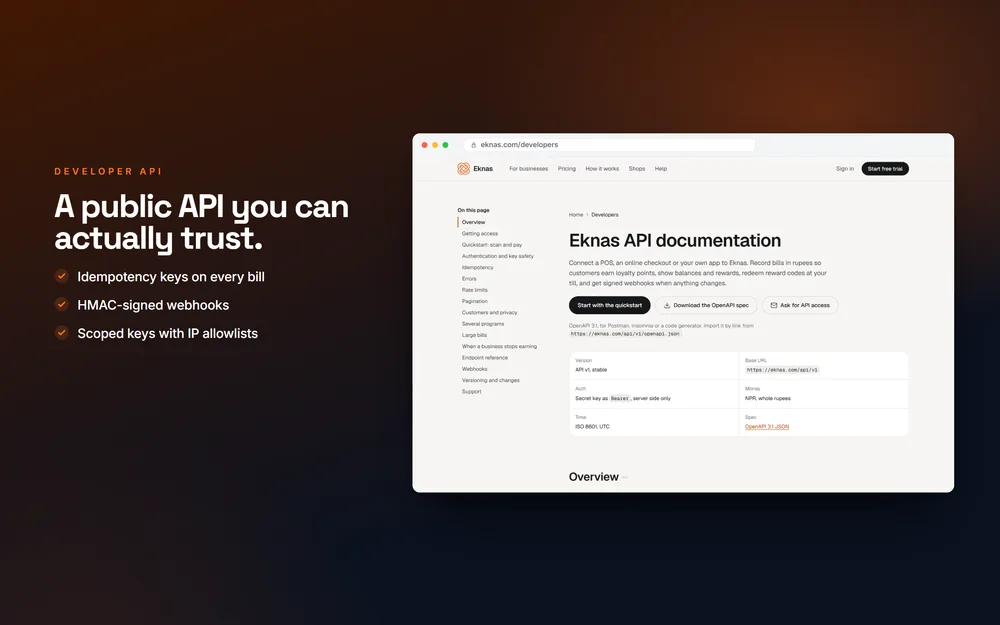
Recording a bill or a redemption needs an Idempotency-Key. If the till retries after a dropped connection, the second request returns the original result with duplicate: true, and reusing a key for a different bill returns a clear 409 error.
Secret keys are stored only as keyed hashes and limited by 7 permission scopes. Voiding is off by default, a key can have an IP allowlist and an expiry, and requests from browsers are refused.
Every webhook is signed with HMAC-SHA256 and carries a timestamp with a 5-minute tolerance. Webhooks go only to public HTTPS addresses, never to private or local networks.
The API returns a customer’s first name and initial and only the last three digits of their phone. A number that doesn’t belong to the shop returns 404, so nobody can test numbers to see who uses Eknas.
04Payments
Payment gateway integration in Nepal starts here: most customers pay with eSewa, Khalti, Fonepay QR or a bank transfer, and buyers abroad use PayPal or a card. A payment integration has to confirm every payment on the server, record it exactly once, and leave a clear record when something fails.
In eSewa, Khalti, Fonepay QR or by card, for an order your server already created.
Order: pendingThe redirect says “success”, but anyone can type that address into a browser.
Not proof yetIt asks the provider directly for the transaction’s status, amount and ID.
Verified on the serverA unique transaction ID and an idempotency key stop double orders on refresh or retry.
Order: paidA receipt or VAT invoice goes out, and a daily report matches orders to the provider’s records.
Reconciled dailyProducts I’ve built take payment this way: Nimtto through Khalti, eSewa and Fonepay QR in Nepal and PayPal or card abroad, and Eknas through eSewa, Khalti, Fonepay or bank QR.
Building a store around these payments? See my web developer in Nepal page for online stores from NPR 60,000, or SaaS development for subscription billing in rupees.
05Security
In layers: strong sign-in and hashed keys, the narrowest permissions possible, validation and rate limits on every route, signed webhooks, and safe defaults for anything that calls out to the internet. Most layers come from products I’ve shipped.
06Integrations
Third-party services I’ve connected in real products. If the one you need isn’t here, the method is the same: read the documentation, build the connection with retries and logging, and test the failure cases.
| Service | Used for | Project |
|---|---|---|
| Google Gemini | Resume scoring, trip planning, complaint triage from photos | RecruitFlow, HamroYatra, CivicSathy |
| Google OAuth | Sign-in with Google | HamroYatra, RecruitFlow |
| Resend | One-time sign-in codes by email | HamroYatra, RecruitFlow |
| Supabase | Auth, file storage and real-time chat | RecruitFlow |
| Cloudinary | Image uploads | HamroYatra |
| Cloudflare for SaaS | Custom domains with automatic certificates | Jhino |
| Model Context Protocol | AI assistants reading company data safely | Eutaa |
| Leaflet & OpenStreetMap | Maps and a complaint heatmap | CivicSathy |
| Formspree | Booking enquiries without a server | Hotel Aarohi |
Case studies: RecruitFlow, Jhino, Eutaa, CivicSathy, HamroYatra and Hotel Aarohi.
07API gateway
An API gateway sits in front of your services and handles keys, rate limits and routing in one place. Most small and medium projects don’t need a separate gateway product, because the same checks can live in the API itself or at Cloudflare. I add one when several services share one public address.
Clients
Services
HeliGo Nepal is a real example of the split: its AI trip planner runs as a separate FastAPI service, so bookings keep working if the AI is slow or down. Read the HeliGo Nepal case study.
08Process
I write the contract before the code. We agree the endpoints, data and errors in an OpenAPI file, I build and test against it, and you get working documentation and keys at the end.
Endpoints, fields, errors and permissions agreed in an OpenAPI file.
Each endpoint tested, including retries, bad input and expired keys.
Reference docs and guides with working examples for integrators.
Keys, dashboards, logs and the repository, in your name.
09Pricing
A single integration into an existing system is quoted after I’ve seen the code, because the effort depends far more on that system than on the API itself. API work inside a new product is part of the build.
| Project | Price | Timeline |
|---|---|---|
| Payment gateway integrationeSewa, Khalti, Fonepay or bank QR into an existing site | Quoted per integration | After I see the code |
| API or webhook for partnersDocumented in OpenAPI, with keys and signed webhooks | Quoted per module | Agreed in writing |
| SaaS product with its APIAccounts, plans, payments and an admin console | NPR70,000 | 6–12 weeks |
Not included: provider fees from eSewa, Khalti, Fonepay or banks, hosting and paid services. Clients abroad are quoted in USD. All prices are on my services page; the data side is on my database design page.
Cost, payments, security and documentation, answered before you ask.
Ask me on WhatsAppA single integration into an existing system, such as a payment gateway or an SMS provider, is quoted after I’ve seen your code, because the effort depends far more on that system than on the API. API work inside a new product is part of the build; a SaaS product’s first version starts from NPR 70,000.
Yes. I connect eSewa, Khalti, Fonepay QR and bank transfer for customers in Nepal, and PayPal or card for buyers abroad. Every payment is confirmed on the server and recorded exactly once, so a refreshed page or a retried request can’t create a second order. Developers can follow my eSewa and Khalti payment integration guide.
Three ways together. The server confirms the payment with the provider instead of trusting the redirect. Each transaction ID is unique in the database. And requests that create money records need an idempotency key, so a retry returns the first result, as in the Eknas API, instead of adding a second record.
Use REST for most business APIs and for anything partners will integrate with, because it’s simple to cache, document and debug. GraphQL suits an app with many screens that each need a different slice of related data, when the same people control both the app and the API.
I write an OpenAPI file that describes every endpoint, field, error and permission, as I did for the Eknas public API in OpenAPI 3.1. Developers can import it into Postman or a code generator, and I add short guides with working examples for the common tasks.
Keys are stored only as hashes, each key gets the narrowest permissions it needs, and sensitive routes have rate limits. Input is validated on every request, webhooks are signed, and outgoing calls only go to public HTTPS addresses. Secret keys never go to the browser.
A webhook is a message your system sends to another when something happens, such as a bill being recorded. I sign each one with HMAC-SHA256 and a timestamp, as in Eknas, so the receiver can check it really came from you and isn’t an old message replayed after five minutes.
Yes. I read the other system’s documentation, build the connection with retries and logging, and give you a simple status view so you can see when a sync fails and why. If the other system has no API, we can look at file exports or webhooks instead.
An API gateway sits in front of your services and handles keys, rate limits and routing in one place. Most small and medium projects don’t need a separate gateway product, because the same checks can live in the API itself or at Cloudflare. I add a gateway when several services share one public address.
Yes. I read the code and any current docs first, add tests around the endpoints you rely on, then fix or extend without breaking existing clients, using a new version where a change would. If there’s no documentation, I write an OpenAPI file as part of the work.
Send a short note about the systems involved, the data that needs to move and your deadline. I reply within one working day with questions or a first estimate.
Ujjwal RupakhetiReplies within one working day
What do you need?
Opens WhatsApp with your message started.