I’m Ujjwal Rupakheti, a full-stack developer in Itahari who builds SaaS products in Nepal. I’ve built and launched SaaS products like Jhino, Eknas and Nimtto, so I build your first version with the whole business in mind: sign-up, plans, billing in rupees, dashboards, roles, backups and the marketing site.
First version from NPR 70,000, in 6–12 weeks
Payments by eSewa, Khalti, Fonepay, bank QR or card
A SaaS MVP is the smallest version of your product that a real customer will pay for. It needs fewer features than most founders plan, but it can’t skip the basics: accounts, a plan and a way to pay, the one workflow that solves the problem, an admin view and a way to get help.
In the First Version Weeks 1–12
Sign-up, sign-in and password reset
Customer accounts with roles and invites
The one core workflow, done well
Plans, payment and invoices
An admin console for you
A marketing site with pricing and FAQ
Usually After Launch Once Customers Ask
A second or third workflow
Native mobile apps
Advanced analytics
Integrations customers request
Referral and affiliate schemes
A public API
Not sure where your cut-off is? A free consultation call is often enough to agree what the first version needs.
02Proof
SaaS Products I Have Built and Launched
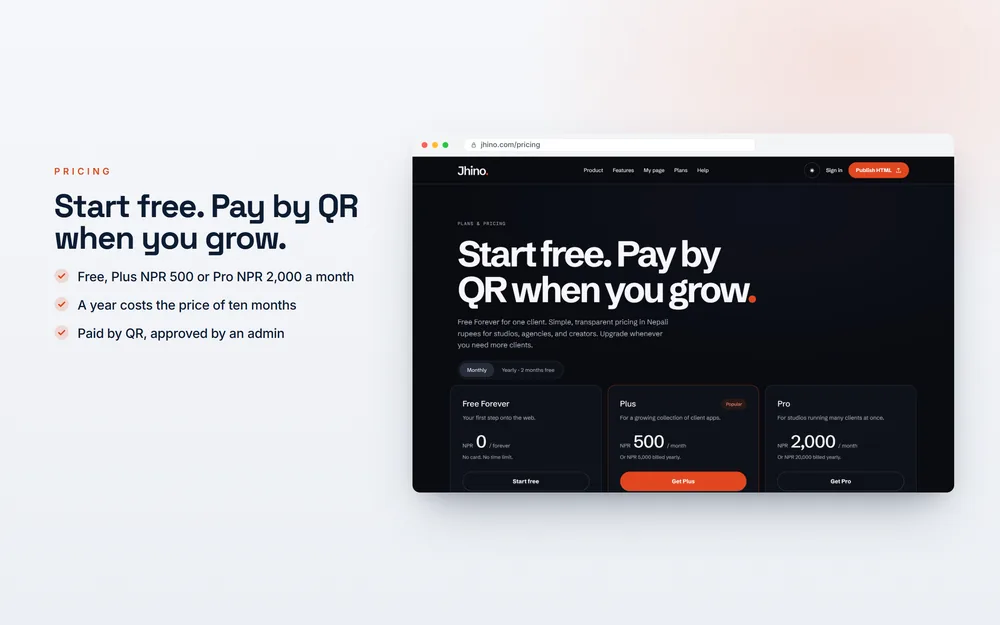
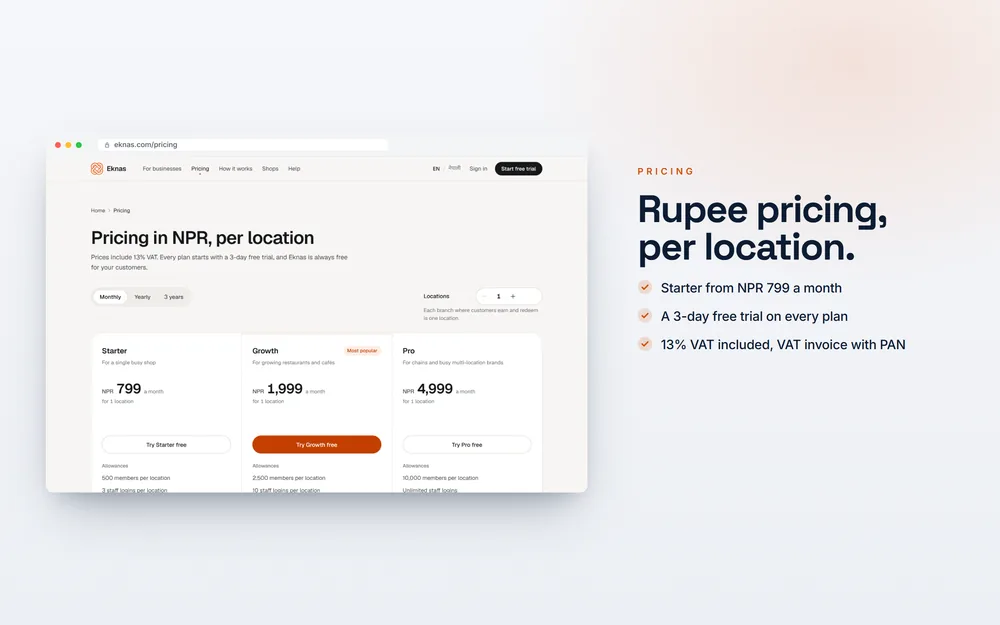
Three of my SaaS products are live with public pricing, each on a different model: monthly plans with a free tier, monthly plans per location, and one-time plans. The case studies show the pricing pages, the architecture and the trade-offs.
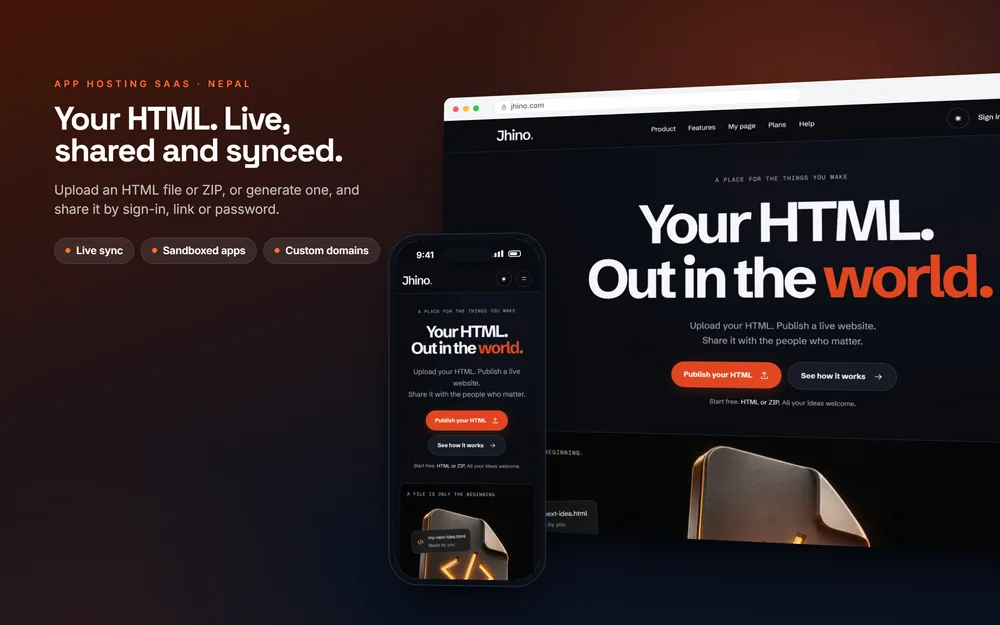
Upload an HTML file or ZIP and it goes live with sign-ins, sharing and live sync. One TypeScript program on Fastify 5 and SQLite, tested in Chromium, Firefox and WebKit.
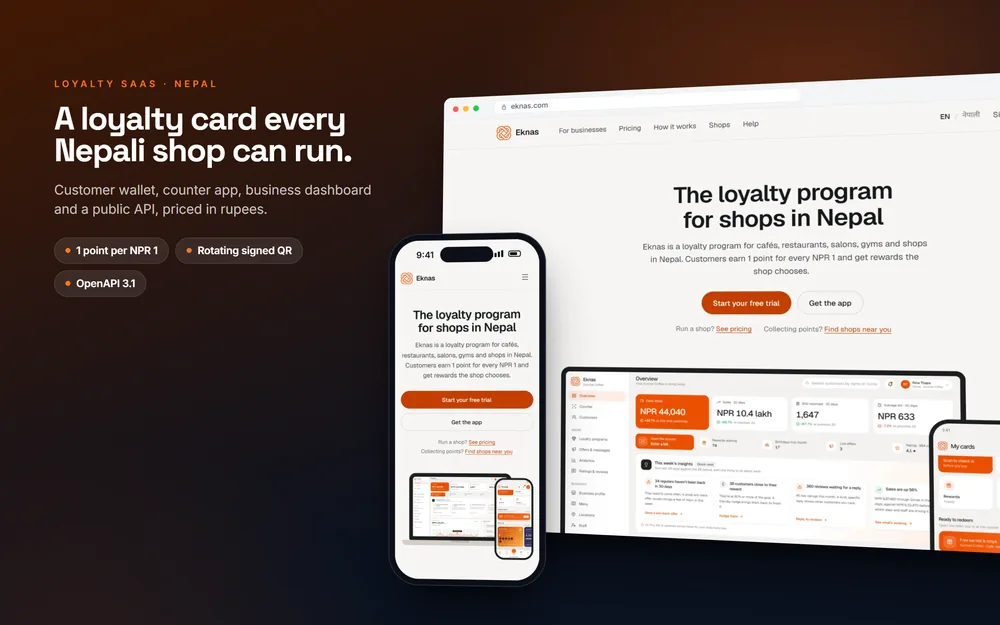
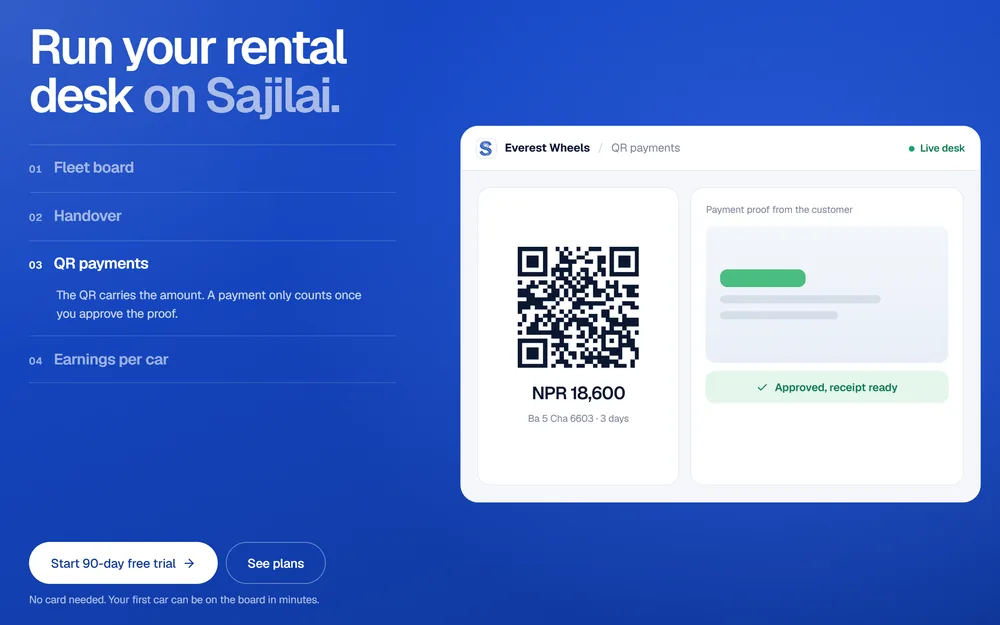
A customer wallet, a counter app and an owner dashboard for cafés, salons, gyms and shops, with rotating signed QR codes and a public API documented in OpenAPI 3.1.
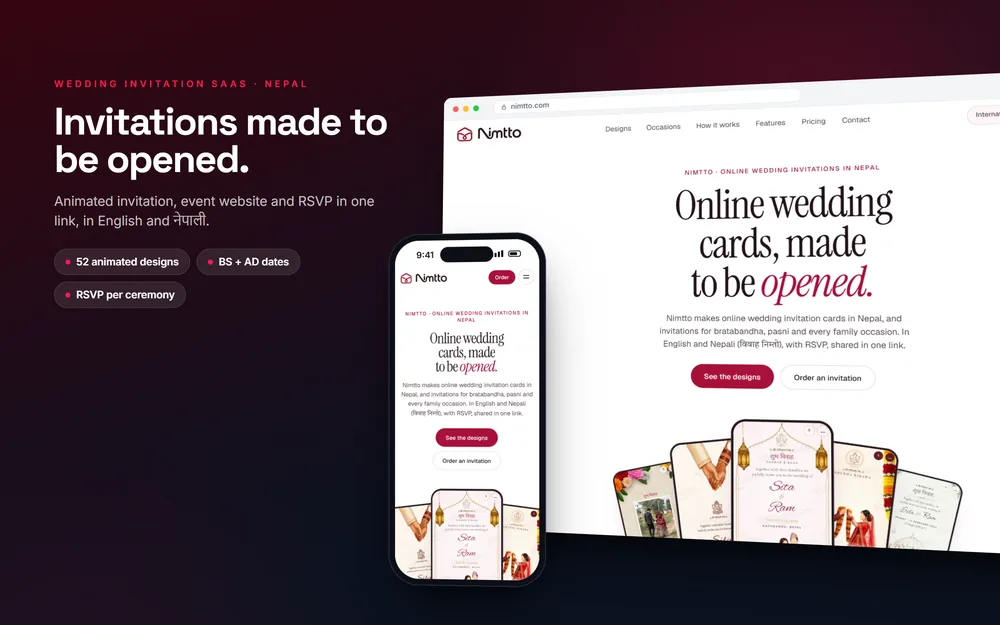
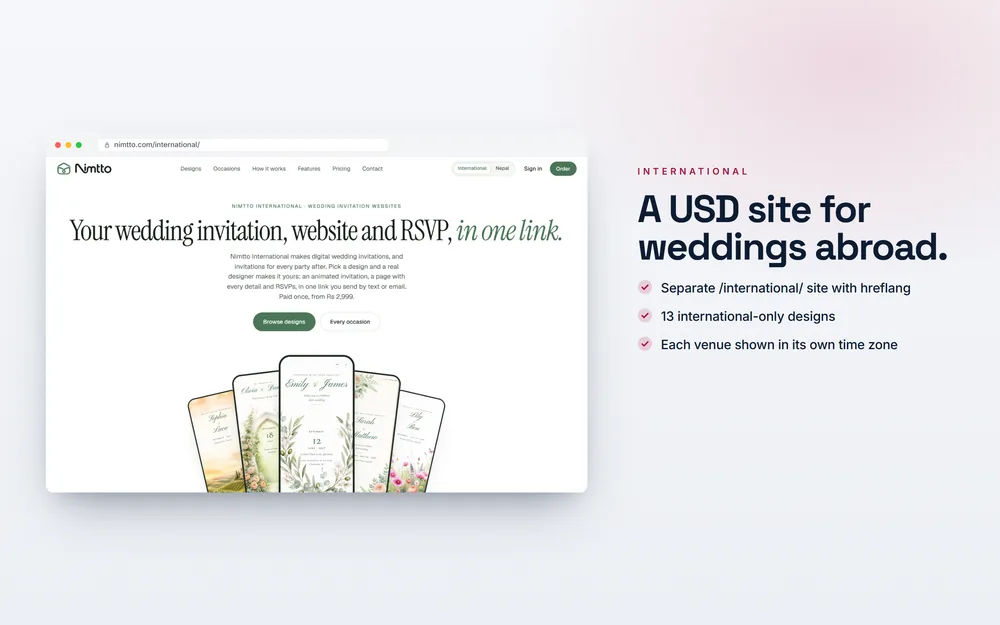
52 animated designs with Bikram Sambat dates and RSVP per ceremony. Paid once by Khalti, eSewa or Fonepay QR in Nepal, or PayPal and card abroad on a separate international site.
I saw a real problem in the Nepali market: online wedding invitations were made for Western weddings, not for ours. Ujjwal Rupakheti helped me bring my idea to reality. He built Nimtto with Nepali and English, Bikram Sambat dates and RSVPs for every ceremony, exactly the way I imagined it.
Businesses in Nepal rarely know who their regular customers are, or whether an offer actually brings anyone back. Ujjwal Rupakheti built Eknas to change that: a free wallet for customers, a counter app where staff record a purchase by phone number or QR code, and a dashboard where owners run offers and see results by branch. He understood the problem and built every part of it properly.
EknasLoyalty program SaaS for businesses in Nepal · eknas.com
03Architecture
Multi-Tenant SaaS Architecture, Explained Simply
Multi-tenant means one application serves many customer accounts, and each account sees only its own data. For most MVPs the safest approach is one shared database where every record carries an account ID, filtered on the server for every query, never in the browser.
AShop A, signed in
BSalon B
CGym C
SELECT * FROM bills WHERE account_id = $current
AccountBillAmount
A#1042NPR 1,250
B#0388NPR 860
A#1043NPR 2,400
C#0211NPR 3,100
Shared database, account ID on every row Default for MVPs
Cheapest to run and simplest to update. It suits almost every early SaaS.
Row-level security in PostgreSQL Extra safety
A second check inside the database itself, in case application code ever forgets the filter.
A database per customer Strict compliance
The strongest separation, but it costs more and makes every update slower.
In Eknas, every shop is an account with branches and staff, and one permission model means a cashier, a manager and an owner see different data from the same screens. In Jhino, each customer’s app runs in a sandboxed iframe and reaches its own data only through a private handshake. The schema side of this is on my database design page.
04Billing
Taking Payments for a SaaS Built in Nepal
A SaaS sold in Nepal usually takes payment through eSewa, Khalti, Fonepay or bank QR and handles renewals and invoices itself, because Stripe doesn’t support businesses registered in Nepal. Customers abroad can pay by PayPal or card.
Renewal reminder sent
Invoice #0142Sample, monthly plan
Pro plan, one month
NPR 1,500.00
VAT 13%
NPR 195.00
Total
NPR 1,695.00
eSewa
Khalti
Fonepay QR
Bank QR
Card abroad
Paid, confirmed with Khalti on the server
Billing Models I’ve Built
One-time plans (Nimtto)
Monthly plans per location, with VAT invoices carrying the shop’s PAN (Eknas)
A free tier, monthly upgrades and a year for the price of ten months (Jhino)
Free trials (Eknas: 3 days)
What Billing Needs
Plan limits enforced on the server
Receipts and VAT invoices
Reminders before a plan expires
A grace period instead of instant lock-out
USD prices for customers abroad
Every payment is confirmed with the provider on the server and recorded exactly once. How I build those integrations is on my API and payment integration page.
05Included
What’s Included in a SaaS Build
Four areas: the product your customers use, the business tools you use to run it, the security that protects their data, and the marketing site that brings them in. Most items come straight from products I’ve already shipped.
Product
Sign-up, onboarding and settings
The core workflow and dashboards
Roles and invites
Email notifications
Installable on phones as a PWA
Business
Plans, payments and invoices
An admin console with customers and orders
Usage limits per plan
CSV exports for your accounts
An audit log of important actions
Security
argon2id password hashing
HttpOnly, SameSite session cookies
CSRF tokens and a strict CSP
Rate limits on sign-in
Daily backups, restore tested
Growth
A marketing site with pricing and FAQ
Structured data, sitemap and hreflang
An llms.txt file for AI assistants
Analytics and Search Console
Landing pages for buyer searches
The Growth column is where my SEO work comes in. For a product that needs to be found, see SEO in Nepal and my guide on how to do SEO in 2026.
06Process
From Idea to Paying Users: The SaaS Timeline
A first version usually takes 6 to 12 weeks. We fix the scope and data model first, build in weekly releases you can click through, put the product in front of a few real users, and launch when payments and support work end to end.
01
Scope & Data Model
Week 1: users, plans, the core workflow and the database design, in writing.
02
Clickable Flow
The main screens as a working link, so you can show early users.
03
Weekly Builds
Accounts, the core workflow, billing and admin, one release a week.
04
Beta
A small group of real customers uses it while I fix what they find.
05
Launch
Payments live, marketing site indexed, backups and monitoring on.
Founders abroad: we talk over video calls, email or WhatsApp, and I work on Nepal time (UTC+5:45).
07Pricing
How Much Does SaaS Development Cost in Nepal?
With me, the first version of a SaaS product starts from NPR 70,000 and usually takes 6 to 12 weeks. The price depends on user roles, integrations and payment flows, and it is fixed in writing before the build starts. The calculator below prices each of those, line by line.
Starting prices for SaaS development in Nepal, updated November 2026
Project
Starting price
Typical timeline
SaaS product, first versionAccounts, plans, payments, an admin console and the marketing site
NPR70,000
6–12 weeks
Larger SaaS productSeveral roles, integrations or a public API
After a paid discovery week
Released in stages
After launchFixes, new features, backups and monitoring
Monthly retainer
Optional
You Pay the Running Costs
Hosting, domain, email sending and any AI or SMS services are paid by you directly. For an early product on one server they are usually small, and SQLite on one server, as in Nimtto and Jhino, is often enough until real traffic arrives.
More user roles raise the price
So does each integration
And each payment flow or plan type
Cutting features is the fastest way to launch
Native apps usually wait for version two
Founders abroad are quoted in USD
Building something simpler first? Websites start from NPR 18,000 and online stores from NPR 60,000 on my web developer in Nepal page. All prices are on my services page.
08Quotation
SaaS Development Cost Calculator: Build Your Quotation
The first version covers sign-up, two customer roles with invites, one core workflow of up to 8 screens, plans with eSewa or Khalti, invoices and your admin console. Tick what your product needs on top, see the total and the payment stages, then download the quotation as a PDF or send it to me.
Each extra user role adds NPR 15,000 because it needs its own permissions, screens and tests; each extra payment method adds NPR 10,000 for the server-side check and the record that stops a payment counting twice, as I describe in my eSewa and Khalti integration guide. A product with several workflows is scoped in a paid discovery week instead. Running a simpler business online? Compare the static website, WordPress website and online store packages.
09Global
Build Your SaaS from Nepal, Sell It Anywhere
You can build a SaaS from Nepal for customers in Nepal, abroad, or both. For founders abroad I work as your full-stack developer on a weekly release schedule. For Nepali founders selling abroad, I add USD pricing, card payments and a separate international site.
Nimtto shows the second case: a Nepal site in rupees and an international site in USD with its own design range, kept apart with hreflang so Google shows each audience the right version. Founders abroad get contracts and invoices in USD, payment by bank transfer, Wise or PayPal, and an NDA if they want one. More on how I work on my software development page.
How Much Does It Cost to Build a SaaS MVP in Nepal?
With me, the first version of a SaaS product starts from NPR 70,000. The price grows with the number of user roles, integrations and payment flows: an extra role adds NPR 15,000, an extra payment method NPR 10,000 and a public API NPR 20,000. Hosting, domains and paid services such as email or AI APIs are billed to you directly, and founders abroad are quoted in USD. My guide on how to build a SaaS in Nepal covers scope, stack and billing in rupees.
Can I Get a SaaS Quotation as a PDF?
Yes. Tick what your product needs in the SaaS cost calculator on this page and press “Download quotation”. You get a PDF with a quotation number, every line and its price, the payment stages, what isn’t included and the terms. Send it to me, and I confirm the scope on a short call before anything is fixed.
How Long Does a SaaS MVP Take to Build?
Most first versions take 6 to 12 weeks. The first week fixes the scope and the data model, and from then on you get a working link every week. Cutting the feature list is the fastest way to launch sooner, and larger products are released in stages.
Can My SaaS Accept eSewa, Khalti and Fonepay?
Yes. Products I’ve built take payment through Khalti, eSewa, Fonepay and bank QR in Nepal, and PayPal or card for customers abroad. Plans can be one-time, monthly or yearly, with VAT invoices where you need them, and every payment is confirmed on the server.
Can a SaaS Built in Nepal Use Stripe?
Not directly, because Stripe doesn’t support businesses registered in Nepal. A Nepali SaaS usually takes eSewa, Khalti, Fonepay or bank QR and handles renewals and invoices itself, and adds PayPal or card for buyers abroad. Founders with a company registered abroad can use Stripe through that company.
What’s Multi-Tenant SaaS, and Do I Need It?
Multi-tenant SaaS means one application serves many customer accounts, and each account sees only its own data. Almost every B2B SaaS needs it. For most MVPs I use one shared database where every record carries an account ID, and every query is filtered by it on the server.
Which Tech Stack Do You Use for SaaS?
Usually Next.js or React with TypeScript on the front end, Node.js with Fastify or Express on the server, and PostgreSQL through Prisma or Drizzle. For a small product on one server, SQLite is often simpler and cheaper. Everything runs in Docker behind Cloudflare.
Do I Own the Code and the Product?
Yes. After the final payment, the code, the repository, the domain and every service account are in your name. I hand over deployment notes and admin logins, and the product is yours to run, sell or hand to another developer.
Can You Build a SaaS for Customers Outside Nepal?
Yes. I can build a product priced in USD with PayPal or card payments, or one product with a separate international site, as I did for Nimtto. For founders abroad, I invoice in USD and accept bank transfer, Wise or PayPal, and I’m happy to sign an NDA.
Will Google and AI Assistants Find My SaaS?
It launches ready for both: a server-rendered marketing site, structured data, a sitemap, hreflang and an llms.txt file, as on Nimtto and Jhino. Rankings still take content and time, so I can stay on for monthly SEO after launch if you want that.
What Happens After the SaaS Launches?
Every project includes a free bug-fix period. After that, I can stay on for a monthly retainer covering fixes, new features, backups and monitoring, so the person who built the product keeps improving it. You can also take the code to another developer at any time.
Tell Me About Your SaaS Idea. I’ll Scope the First Version.
Send a short note about your customers, the problem you solve and how you plan to charge. I reply within one working day with questions or a first estimate.