Internal Tools & Admin Panels
Approval flows, data-entry screens, dashboards and reports that replace shared spreadsheets. Each person sees only the part of the data their role allows.
I’m Ujjwal Rupakheti, a software developer in Itahari, Nepal, with 3+ years of building for the web. I build custom software for businesses: internal tools, HR and inventory systems, marketplaces, APIs and integrations, in TypeScript, Node.js and Python with PostgreSQL. Eutaa, a company system I built, is used every day at Ektukra Digital Agency.

01The basics
Custom software development means building software around how your business already works, instead of bending your staff to fit a ready-made product. It makes sense when spreadsheets and off-the-shelf tools keep failing at the same step: approvals, stock, payroll rules, bookings or reports.
And one sign you don’t: if a ready-made product already does most of what you need at a fair price, use it. I’ll tell you that on the first call, and it costs you nothing.
Today Five places, no single truth
One system One login, one database
Roles checked on the serverAudit logBS and AD dates
02What I build
Six kinds of software for companies in Nepal and abroad. Each one runs in the browser, works on phones, checks permissions on the server and keeps a record of who changed what. If you plan to sell your software to other businesses, see SaaS development.
Approval flows, data-entry screens, dashboards and reports that replace shared spreadsheets. Each person sees only the part of the data their role allows.
HR, attendance, payroll, inventory and CRM, with Nepali VAT, SSF and TDS where they apply, as in Eutaa.
Several kinds of users and real money moving between them, like the travellers, operators and admins in HeliGo Nepal.
Connect your system to payment gateways, a POS, SMS, email or a partner’s software, with documented endpoints and signed webhooks.
Resume scoring on a fixed rubric with a fallback when the model fails, as in RecruitFlow, and assistants that obey the same permissions as staff.
Schema design, migrations, slow-query fixes and reports your managers can trust, with backups that have actually been restored.
03Proof
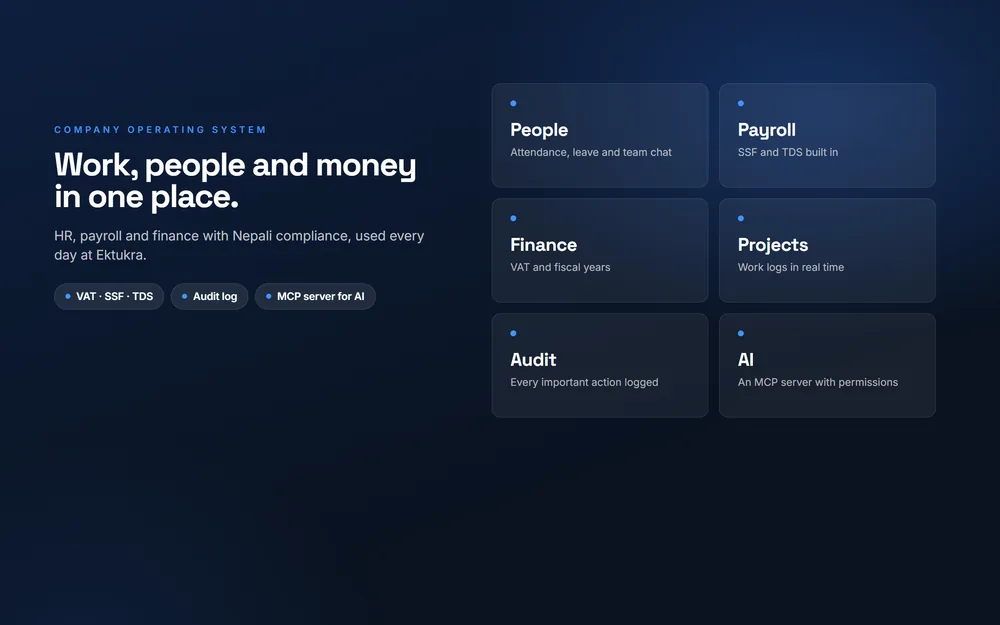
Eutaa, the company operating system I built, is used every day at Ektukra Digital Agency, where I work. It covers HR, attendance, leave, payroll and finance with Nepali VAT, SSF and TDS, plus projects, work logs and staff messaging, on Fastify, Drizzle and PostgreSQL.
It replaced an older internal platform. The rebuild moved every permission check to the server, added an audit log of important actions, and includes an MCP server so AI assistants can read company data only through the same rules a person has.
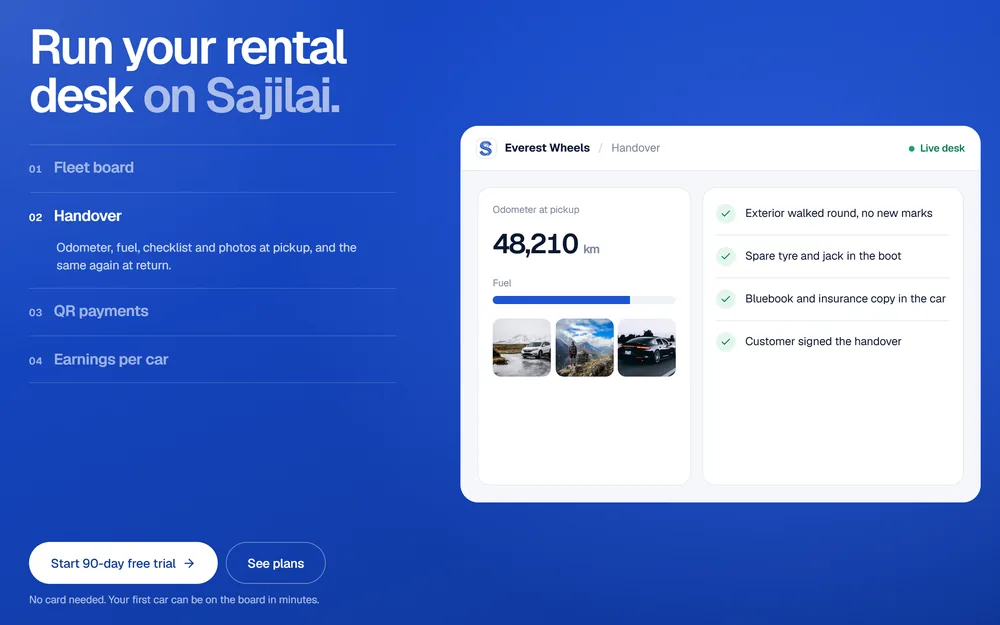
SajilaiRental bookings that cannot overlap, exact prices for any dates, dynamic QR payments and handovers recorded with photos and fuel levels.
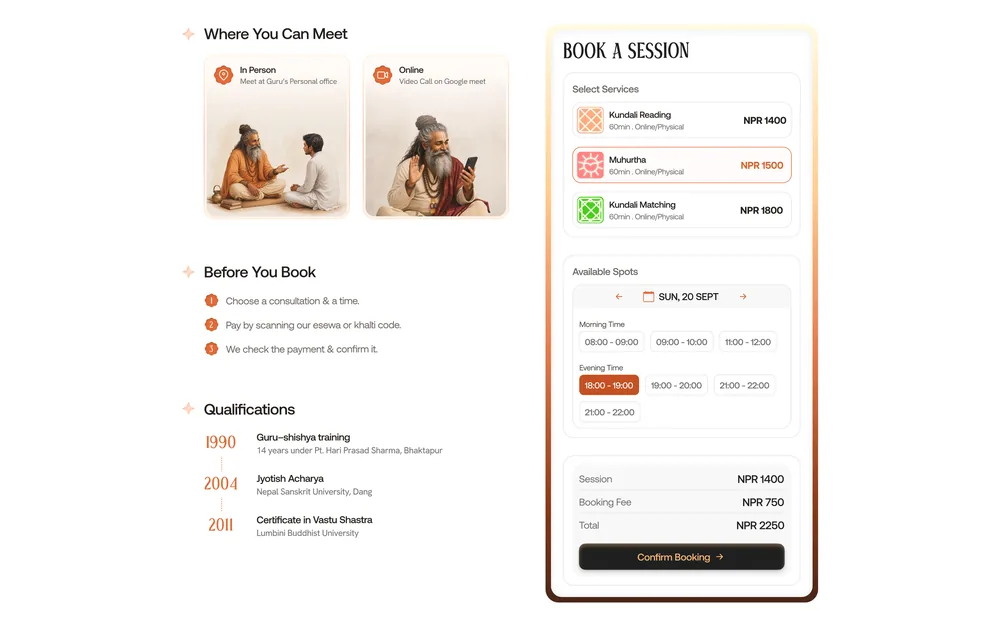
GuruSangaGuru bookings from real slots in each guru’s diary, QR payments checked by staff and Google Meet rooms that open on time.
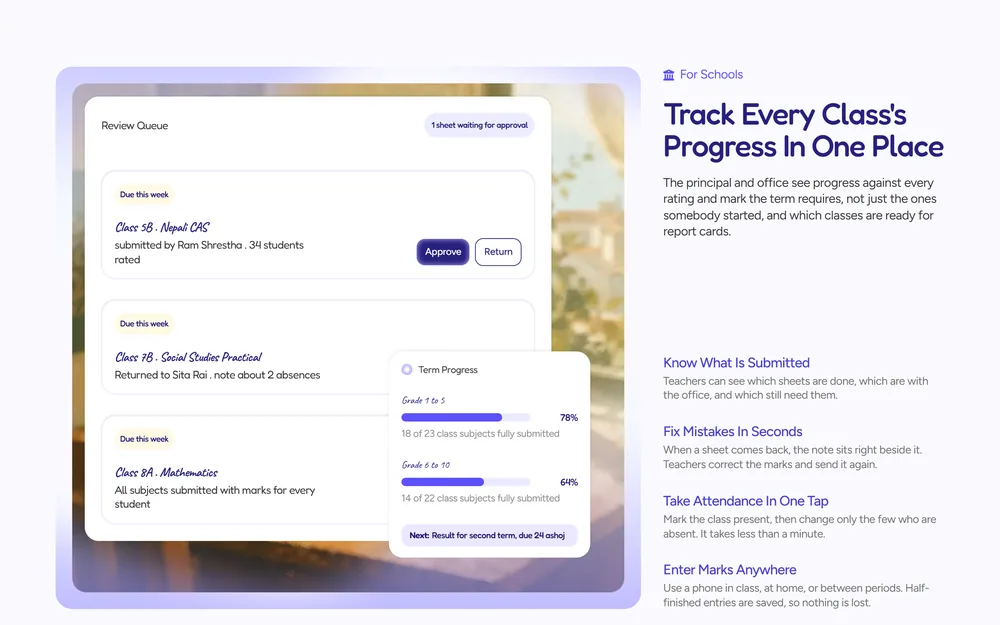
PrishtaSchool marks that move from teacher entry to office review and lock, worked on at Ektukra with 1,061 API tests.
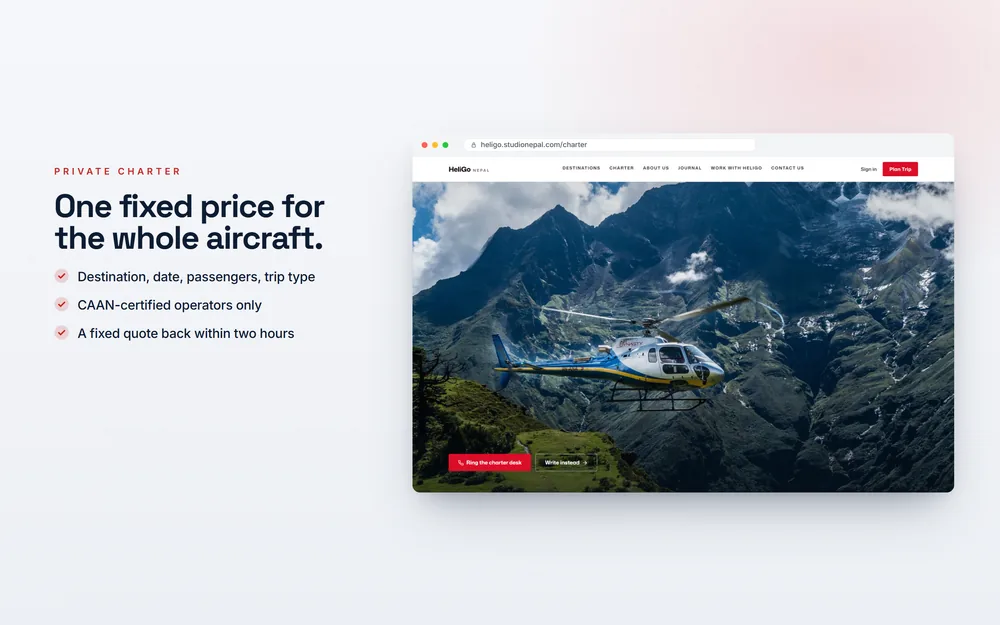
HeliGo NepalTravellers, operators and admins in one React and Express app. Every amount is stored in paisa, and the AI trip planner runs as its own FastAPI service.
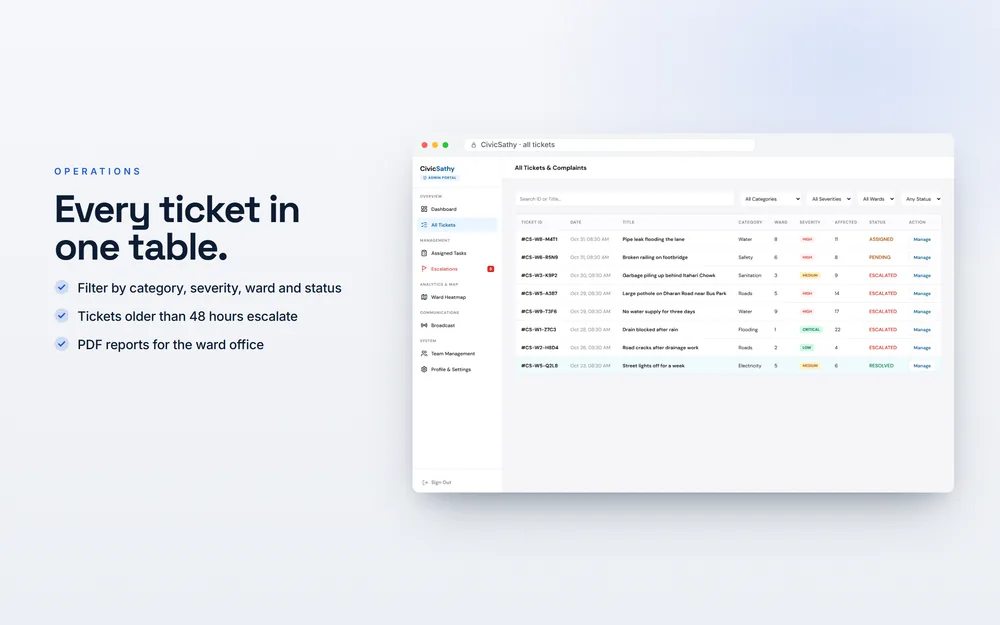
CivicSathyA Java 17 complaint system on MySQL designed for Itahari’s wards, built as a university project, with AI triage from photos and a ward heatmap.
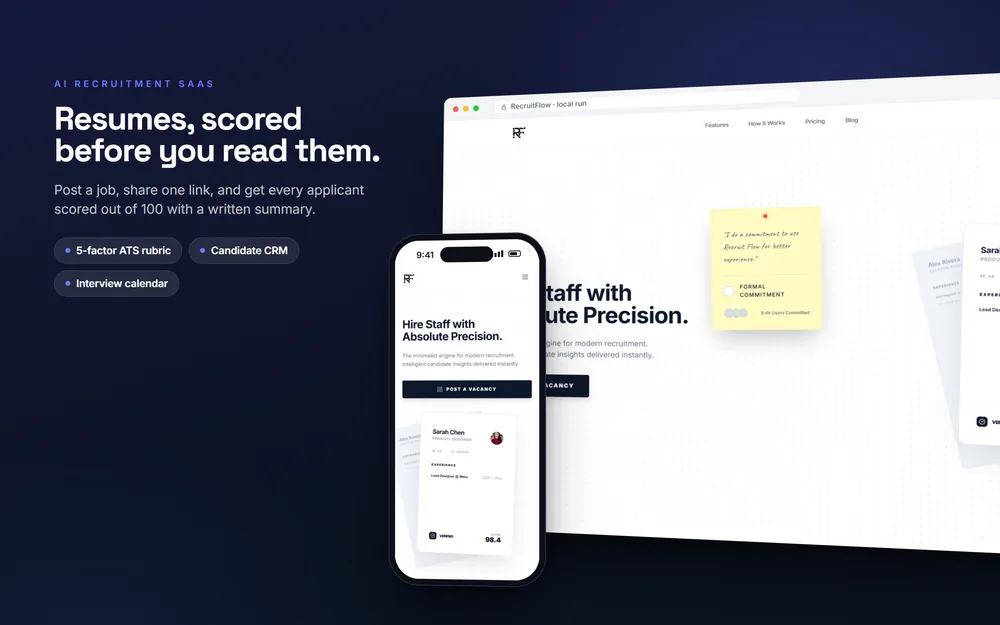
RecruitFlowResumes scored out of 100 by Gemini on a fixed rubric, with a rule-based fallback when the model fails. Source code on GitHub.
04Reliability
Reliable software comes from a few habits applied every time. These come from my own products, and I bring every one of them to client work.
role check → 403Hiding a button is not security. In Eutaa, Eknas and HeliGo Nepal every request is checked against the user’s role, so a cashier, a manager and an owner see different data from the same screens.
amount_paisa BIGINTHeliGo Nepal stores every amount as a whole number of paisa, so commissions, refunds and settlements split without rounding errors and always add up to what the traveller paid.
Idempotency-KeyIn Eknas, recording a bill needs an idempotency key. If the till sends the bill again after a dropped connection, the server returns the first result instead of adding points twice.
chromium · firefox · webkitJhino’s test suite runs in all three with Playwright, and CI checks every push. For you, I add tests around the flows that cost money when they break, as in regression testing.
argon2id · HttpOnly · CSRFPasswords hashed with argon2id, sessions in HttpOnly cookies, CSRF tokens on forms, a strict Content-Security-Policy and rate limits on sign-in and other sensitive routes.
14 daily backups keptDaily backups with 14 copies kept, as in Jhino and Nimtto, plus a test restore before launch. A backup nobody has restored is only a hope.
05Stack
I write most back ends in TypeScript on Node.js, with Fastify or Express, and use Python with FastAPI or Flask for AI and data work. Data lives in PostgreSQL through Prisma or Drizzle, and everything ships in Docker.
I choose well-known, well-documented tools on purpose. Any capable developer in Nepal can read and maintain them after me, which protects you if we ever stop working together. My public code is on GitHub.
06Process
A custom software project starts with understanding the work, not the screens. Then you see working software every week until launch.
I talk to the people who will use the system and map the current process, spreadsheets included.
Modules, roles, timeline and price in writing. Larger systems start with a paid discovery week.
A working link every week, starting with the module that hurts most, tested by your staff.
Data moved from your old tools, staff shown how to use it, code and accounts handed to you.
A free bug-fix period, then optional monthly support and new modules as you grow.
We talk on WhatsApp, Viber, email or video calls. I work on Nepal time (UTC+5:45).
07Pricing
Custom software is quoted per module, after a short discovery call or, for larger systems, a paid discovery week. Each module gets a fixed price in writing before any build starts, so you pay for each part as it goes live.
| Project | Price | Delivery |
|---|---|---|
| Internal tool or admin panelApprovals, data entry, dashboards and reports | Quoted per module | Module by module |
| Management systemHR, payroll, inventory or CRM, with VAT, SSF and TDS | Quoted per module | Module by module |
| Integration or APIPayments, POS, SMS, email or a partner’s system | Quoted per integration | After I see the code |
| SaaS product, first versionAccounts, plans, payments and an admin console | NPR70,000 | 6–12 weeks |
Not included: domain, hosting, paid services such as SMS, email or AI APIs, and paid tools. International clients are quoted in USD. Every starting price is on my services page.
Itahari, Nepal
--:--
UTC+5:45, where I work from
London
--:--
Your morning is my afternoon
New York
--:--
Your evening is my morning
Sydney
--:--
Your afternoon is my morning
08International
I work with founders and companies abroad who want a full-stack developer who writes clear English, documents the work and ships a build every week, at Nepal rates. Contracts and invoices are in USD, payment is by bank transfer, Wise or PayPal, and I’m happy to sign an NDA. Here is how to hire a web developer from Nepal, step by step.
I’m a Full Stack Web Developer at Ektukra Digital Agency since June 2026, and I’m studying for a BSc (Hons) in Computing at Itahari International College. The full story is on my about page, and clients in the USA, UK, Australia, Canada and the UAE each have a page on how we’d work.
Cost, timelines, ownership and how I work, answered before you ask.
Ask me on WhatsAppWith me, custom software is quoted per module, because one system can hold a single approval screen or a full payroll engine. Each module gets a fixed price in writing after a discovery call; larger systems start with a paid discovery week. For comparison, a SaaS product’s first version starts from NPR 70,000. My guide to software development cost in Nepal compares market prices and the IRD billing rules.
A focused tool or first module usually takes 6 to 12 weeks, about the same as the first version of a SaaS product. Larger systems are split into modules and launched one at a time. You get a working link every week, so your staff try real screens early instead of waiting for a big reveal.
Yes. I start by reading the code and running it locally, then give you a written list of risks, bugs and quick wins before changing anything. If the code needs a careful review of its business rules first, see my logic verification and code review service.
Mostly TypeScript on Node.js with Fastify or Express, React or Next.js on the front end, and PostgreSQL through Prisma or Drizzle. I use Python with FastAPI or Flask for AI and data work, and Java when a project already uses it, as CivicSathy does with Jakarta Servlets.
Yes. Eutaa, the company system I built and that Ektukra uses every day, handles payroll with SSF and TDS and finance with VAT. I build those rules into the data model, so nobody rebuilds them in a spreadsheet each month. More on my management system software page.
Buy ready-made when a product already fits your process and Nepali rules at a fair price. Build custom when your process is your advantage, when you pay monthly per user for a tool that half fits, or when no product handles VAT, SSF and TDS the way your accountant needs. I’ll tell you which on the first call.
Yes, with limits that keep it safe and predictable. RecruitFlow scores resumes with Gemini on a fixed rubric and falls back to a rule-based engine when the model fails. Eutaa’s MCP server lets AI assistants read company data only through the same permission checks as a person. My guide to AI chatbots for business in Nepal explains the costs and the limits.
Yes. After the final payment, the source code, the repository, the database and the hosting accounts are yours. I hand over the repository, admin logins, deployment notes and a short guide to running the system, so another developer can take over if you ever need that.
Every project includes a free bug-fix period after launch. After that, monthly support covers updates, backups, monitoring and small changes, priced by the size of the system. New modules are quoted the same way as the first one, in writing and before any work starts.
Yes. I work on Nepal time (UTC+5:45), write documentation in clear English and share a working build every week. International work is quoted and invoiced in USD and paid by bank transfer, Wise or PayPal, and I’m happy to sign an NDA before we talk details.
Describe the process you want to fix, the people who will use the system and your budget. I reply within one working day with questions or a first estimate.
Ujjwal RupakhetiReplies within one working day
What do you need?
Opens WhatsApp with your message started.