Family Record
- A shared family tree
- Names in Nepali or English
- Places and stories for each person
08Case study · Family heritage app
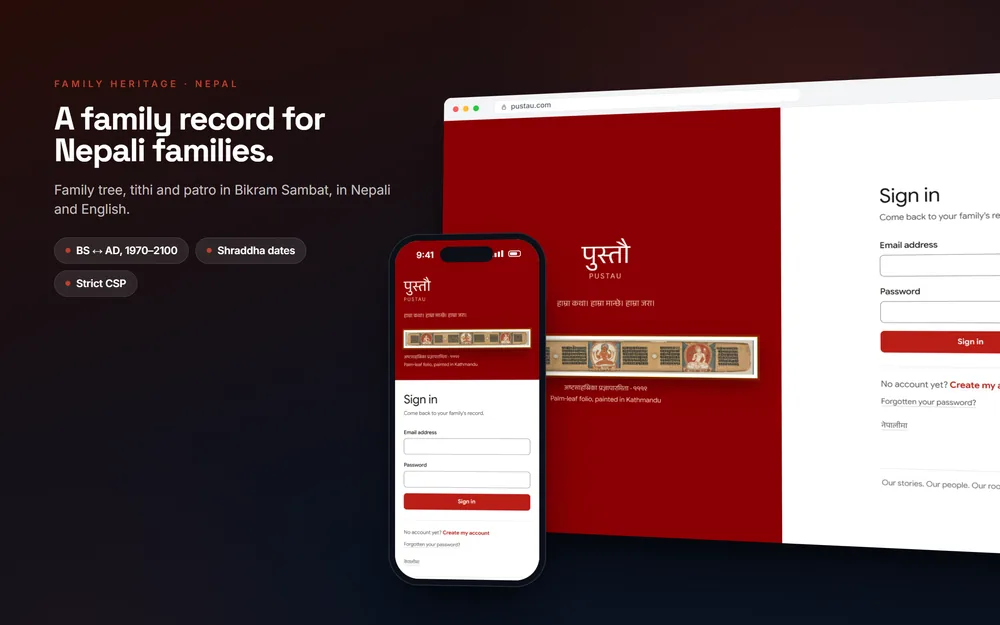
Pustau is a digital vamshavali: a private family tree for Nepali families, with tithi and patro in Bikram Sambat and shraddha dates worked out the way a priest would. I designed and built it with Next.js and PostgreSQL, Nepali first with English one tap away, and it is live at pustau.com.
01The problem
A family’s vamshavali often lives in one elder’s memory or a notebook. When that person is gone, names, relationships and villages go with them.
Ritual dates make it harder. A shraddha is set by the tithi of a death in the lunar calendar, which moves against both the Bikram Sambat and the Gregorian calendars every year. Families rely on a priest to work it out.
हाम्रा कथा। हाम्रा मान्छे। हाम्रा जरा।Our stories. Our people. Our roots. Pustau’s promise, on its home page.
02The solution
Pustau is a private family record. Members add people and relationships to a shared family tree, and record the places and stories behind them. The app shows tithi and patro in Bikram Sambat and works out shraddha dates the way a priest would.
Nepali is the default language, English is one tap away, and names can be written in either script. I build websites and web apps in Nepali Unicode the same way, and Nimtto shows Bikram Sambat dates beside AD for every ceremony.
03Features
A small feature list on purpose: the family record, the calendar that depends on it, and access that stays simple for elders.
04Architecture
Pustau is a Next.js 16 application in TypeScript with PostgreSQL, packaged with Docker. The whole app sits behind sign-in, because a family record is private by nature.
A nonce-based Content-Security-Policy runs in report-only mode with a reporting endpoint, so violations are collected before the policy is enforced and nothing breaks for a family mid-entry.
05Engineering
Pustau is a small product with a hard core: a calendar engine that has to be exactly right, in two languages and two scripts.
01
The Bikram Sambat calendar has no fixed formula; month lengths are published year by year. Pustau’s BS to AD conversion is verified against published data for every day from 1970 to 2100, which covers everyone living today and the next generation. Checking output against published data is what logic verification means in practice.
02
A shraddha follows the lunar tithi of the day a person died, so its date changes every year. Pustau calculates it the way a priest would, so families can see the coming year’s dates without guessing. Getting data like this exactly right is the heart of good database design.
06Status
Pustau is live at pustau.com. Families sign up with a name, an email and a password and start building their record.
Live
It is a small product with a hard core: a calendar engine that has to be exactly right, in two languages and two scripts, behind sign-in because a family’s record belongs to the family.
Related services
These are the services behind this case study. Each page lists prices, timelines and how I work, and every starting price is on my services page.
Every project, with its stack and status side by side, are in my web development portfolio, and the person behind them is on my about page.
What Pustau does, how accurate its dates are and how it keeps a family’s record private.
Ask me on WhatsAppPustau is a private family record for Nepali families, a digital vamshavali. Members build a shared family tree with names, places and stories, and the app shows tithi and patro in Bikram Sambat and works out shraddha dates. Nepali is the default language, with English one tap away.
Pustau’s BS to AD conversion is verified against published data for every day from 1970 to 2100. The Bikram Sambat calendar has no fixed formula, because month lengths are published year by year, so the app checks against that data rather than trusting a calculation.
A shraddha follows the lunar tithi of the day a person died, so its date moves against both the Bikram Sambat and Gregorian calendars every year. Pustau calculates it the way a priest would, so a family can see the coming year’s dates without guessing.
Yes. The whole app sits behind sign-in, because a family record is private by nature. Sign-up needs only a name, an email and a password of at least 10 characters, the site uses HSTS, and a nonce-based Content-Security-Policy runs in report-only mode before it is enforced.
Pustau is a Next.js 16 application written in TypeScript, with PostgreSQL for data. It is packaged with Docker and served behind Cloudflare with HSTS, and it installs as an app on the phone, so elders can open it like any other app.
Yes. I build web apps in Nepali Unicode, English or both, with Bikram Sambat dates where they matter, as in Pustau and Nimtto. I’ll send a fixed quote after a short call about features, languages and data. See web development in Nepal for prices.
Send a short note about your project and budget. I reply within one working day with questions or a first estimate.
Ujjwal RupakhetiReplies within one working day
What are you planning?
Opens WhatsApp with your message started.